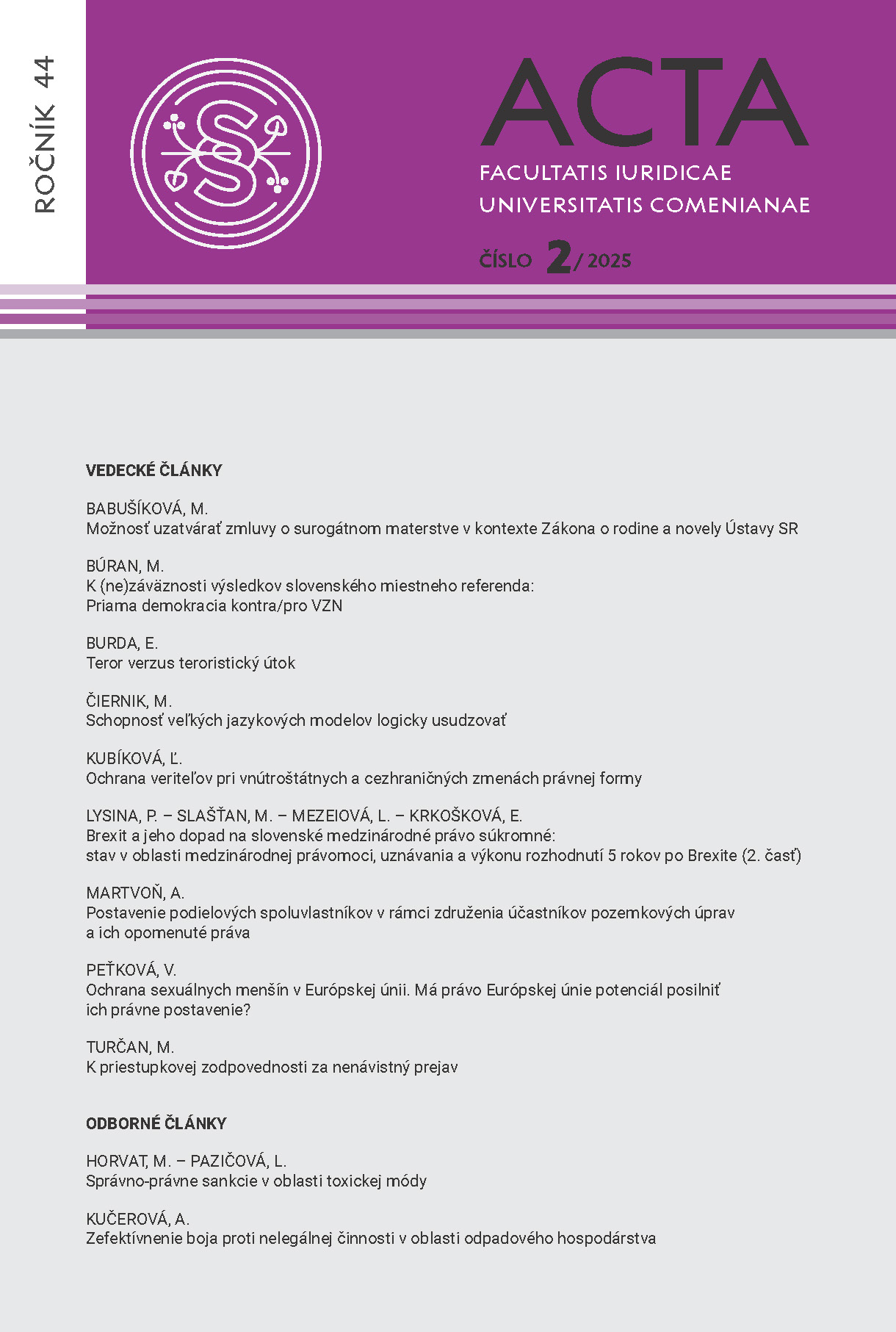
Brexit and Its Impact on Slovak Private International Law: The State of Jurisdiction, Recognition, and Enforcement of Judgments 5 Years After Brexit (2nd part)
DOI:
https://doi.org/10.46282/afi.2025.2.06Keywords:
European Union, Brexit, Brexit Agreement, TCA, member state, non-member state, Court of Justice, private international law, recognition and enforcement of foreign judgments, international jurisdiction, Brussels Ia Regulation, Brussels IIa Regulation, Maintenance Regulation, Insolvency RegulationAbstract
Brexit has fundamentally influenced the legal relationships of private international law between Slovakia and the United Kingdom, exposing the limitations of the previously harmonized legal framework of the European Union. Private international law now faces new challenges, raising the question of whether the existing legal framework sufficiently reflects the reality of the post-Brexit environment, where a unified legal system and the direct applicability of EU law are absent. In this context, the paper focuses on analyzing the impacts of Brexit on private international law five years later, with particular emphasis on the determination of court jurisdiction and the recognition and enforcement of judgments. However, the aim of the paper is not only to identify the persistent issues related to the fragmentation of the legal framework and the loss of harmonization following Brexit but also to propose solutions to these challenges, including the utilization of multilateral conventions and bilateral cooperation, thereby contributing to the strengthening of legal certainty in the new reality of relations with the United Kingdom. The paper is published in two parts.
References
1. ARMSTRONG, K. A. After EU membership: the United Kingdom in transition. In: European journal of legal studies, 2019, vydanie 12, ISSN 1973-2937.
2. BARNARD, C. Law and Brexit. In: Oxford Review of Economic Policy, vydanie 33, číslo, 1. marca 2017, ISSN 0266-903X.
3. BENNET, A., VINES, D. The EU-UK Trade and Cooperation Agreement: lessons learnt. In: Oxford Review of Economic Policy, vydanie 38, číslo 1, Spring 2022, ISSN 1460-2121.
4. BURDOVÁ, K. Vzťah nariadenia Brusel IIb a haagskych dohovorov. In. Výzvy medzinárodného a európskeho práva. Bratislava: Ústav znaleckej činnosti, 2024. ISBN 978-80-975014-1-9.
5. JUCK, D. Proposal for a regulation on parenthood: an important step forward or another missed opportunity? In. Cofola international 2023. Brno: Masarykova univerzita, 2023. ISSN (online) 2788-2772, s. 115-134.
6. LEIN, E. An ‘English Good-Bye‘: Tje United Kingdom and the Lugano Convention. In: NYUJ Int'l L. & Pol., 2023, ISSN 0028-7873.
7. LYSINA, P., BURDOVÁ, K. Slovak Republic. Private international law; suppl. 60. Alphen aan den Rijn: Wolters Kluwer. Kluwer Law International, 2020. ISBN 978-90-411-1555-3.
8. MÖLLER, A., TIM, O. The United Kingdom and the European Union: What would a “Brexit“ mean for the EU and other states around the world? Berlin, 2014, ISSN 1611-7034.
9. PEERS, S. So close, yet so far: The EU/UK Trade and Cooperation Agreement. In: Common Market Law Review, vydanie 59, číslo 1, 2022, ISSN 0165-0750.
10. SOARES, A. G. The United Kingdom withdrawal procedure from the European Union. In: Tribuna Juridica, Societatea de Stiinte Juridice si Administrative, 2020, ISSN 2247-7195.
11. Posúdenie žiadosti Spojeného kráľovstva o pristúpenie k Novému Lugánskemu dohovoru je možné pozrieť na webovom sídle Európskej komisie: https://commission.europa.eu/documents_en?prefLang=sk
Downloads
Published
Issue
Section
License
Copyright (c) 2025 Acta Facultatis Iuridicae Universitatis Comenianae

This work is licensed under a Creative Commons Attribution-NonCommercial-NoDerivatives 4.0 International License.