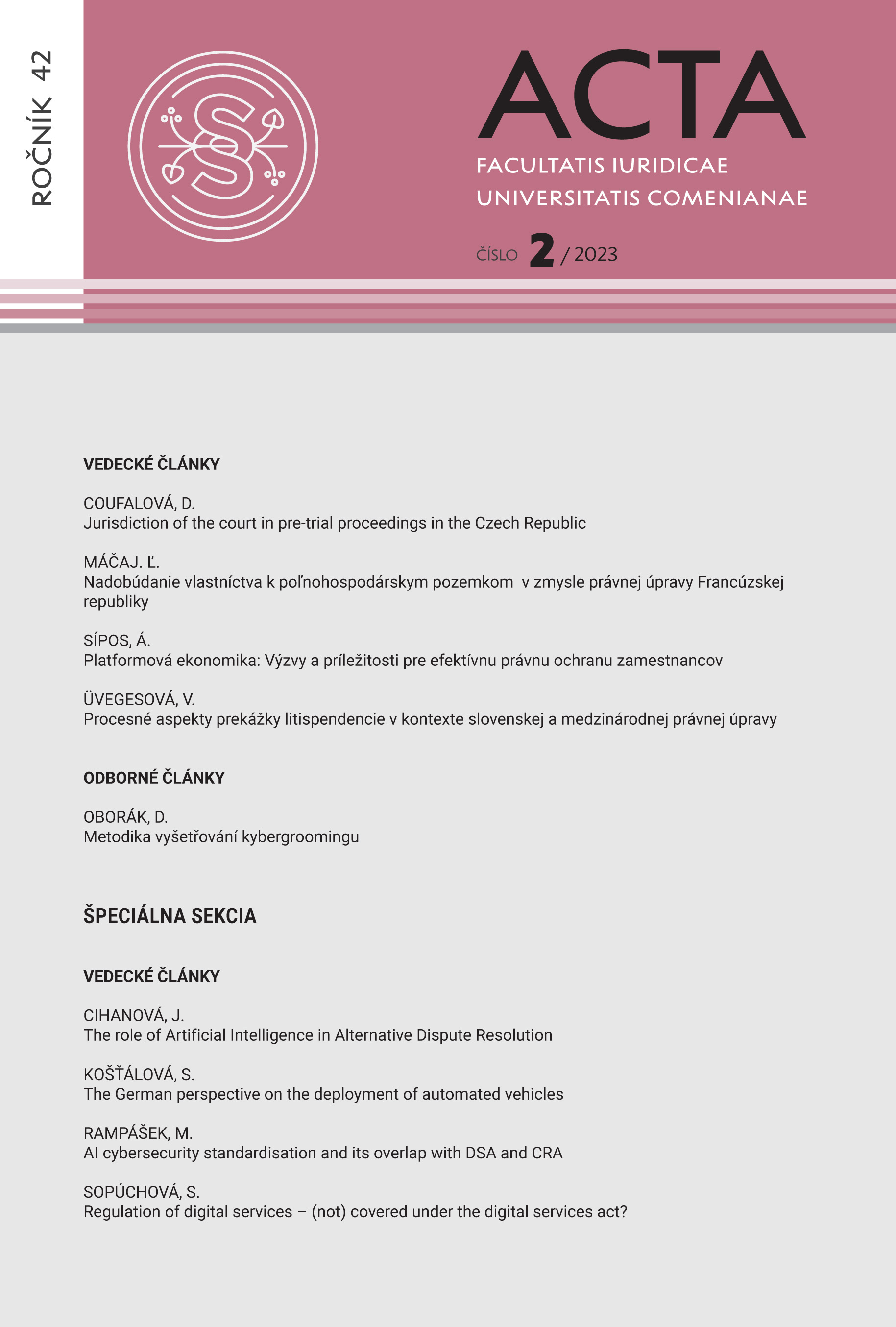
REGULATION OF DIGITAL HEALTHCARE SERVICES – (NOT) COVERED UNDER THE DIGITAL SERVICES ACT?
DOI:
https://doi.org/10.62874/afi.2023.2.09Kľúčové slová:
electronic healthcare services, e-Health, healthcare digitization, digital healthcare servicesAbstrakt
The regulation of digital services is currently experiencing significant growth, primarily due to the adoption of new legal regulation at the European Union level, specifically the Digital Services Act. Digital services play a pivotal role in a country's economy by facilitating cross-border trade and enabling entrepreneurs to reach a vast user base, often comprising consumers. Despite their advantages, these services also entail substantial risks, particularly in relation to their widespread and more challenging-to-regulate usage. Alongside their positive impact, they also contribute significantly to the dissemination of illegal and harmful information. In recent years, there has been a notable development and utilization of new electronic information systems within the healthcare sector, accompanied by electronic healthcare services. This connection is not limited to the Covid-19 pandemic but is also a result of the dynamic evolution of information and communication technologies and their potential in healthcare provision. In this paper, the author analyzes the research question regarding which digital healthcare services in the Slovak Republic fall within the scope of the new European legislation. The author examined European regulations, focusing on the types of electronic healthcare services existing in Slovakia. By synthesizing and applying available information and rules to selected electronic healthcare services, the study concludes that the Digital Services Act has only a limited impact on the functioning of these selected digital healthcare services.
References
1. ANDRAŠKO, Jozef. et al. Law of information and communication technologies 2. Bratislava: TINCT, 2021, 324 p.
2. ANDRAŠKO, J. et al. Regulatory challenges of e-Government in the Slovak Republic in the context of European Union law. Prague: Wolters Kluwer ČR, 2022, 286, 380 p.
3. BOYER, K., HALLOWELL, R., ROTH, A. V. Eservices: operating strategy – a case study and a method for analyzing operational benefits. In: Journal of Operations Management. 2002, year 58, ed. 2.
4. Directive 2015/1535 of the European Parliament and of the Council of the European Union establishing the procedure for providing information in the field of technical regulations and rules relating to information society services
5. Law no. 576/2004 Coll. on health care, services related to the provision of health care and on amendments to certain laws
6. Law no. 95/2019 Coll. on information technologies in public administration
7. Regulation (EU) 2022/2065 of the European Parliament and of the Council of 19 October 2022 on the single market for digital services and amending Directive 2000/31/EC (Digital Services Act)
8. Regulation (EU) 2022/1925 of the European Parliament and of the Council of 14 September 2022 on competitive and fair markets in the digital sector and amending Directives (EU) 2019/1937 and (EU) 2020/1828 (Digital Markets Act)
9. SOPÚCHOVÁ, S. Electronic healthcare in the Slovak Republic. E-Health and telemedicine. Bratislava: Wolter Kluwers, 2022, 135 p.
10. SOPÚCHOVÁ, S. Artificial intelligence and its use in the process of providing health care. In: Human rights. From reality to the virtual world. Jósefów: Alcide De Gasperi University of Euroregional Economy in Józefów, Poland, 2021, 368 p.
11. STŘEDA, L., HÁNA, K. eHealth and telemedicine. Prague: Grada Publishing, 2016, 160 p.
12. UNESCO. Developing and Using Indicators of ICT Use in Education. Bangkok: UNESCO Asia and Pacific Regional Bureau for Education, 2003, 138 p.
Downloads
Publikované
Číslo
Sekcia
License
Copyright (c) 2023 Acta Facultatis Iuridicae Universitatis Comenianae

This work is licensed under a Creative Commons Attribution-NonCommercial-NoDerivatives 4.0 International License.